Here’s a trick a lot of brands use. They slap “genuine leather” on a tag and let you assume that means good quality. It doesn’t. It’s actually one step above fake.
If you’re buying a wallet, bag, or belt and want it to last, you need to know what’s actually under that label. Here’s the real breakdown, no fluff.
How a Hide Gets Split
Picture a cross-section of animal hide. It has layers, like a piece of wood:
- Top layer (the grain): tightest, densest fibers. This is the strongest part of the skin.
- Middle layer: fibers get looser as you go down.
- Bottom layer (corium): loosest fibers, weakest part.
A tannery slices this hide into layers depending on what they need. That single decision, which layer ends up in your wallet, is what separates full grain from top grain from genuine leather. Same animal, same hide, completely different product.
What Is Full Grain Leather
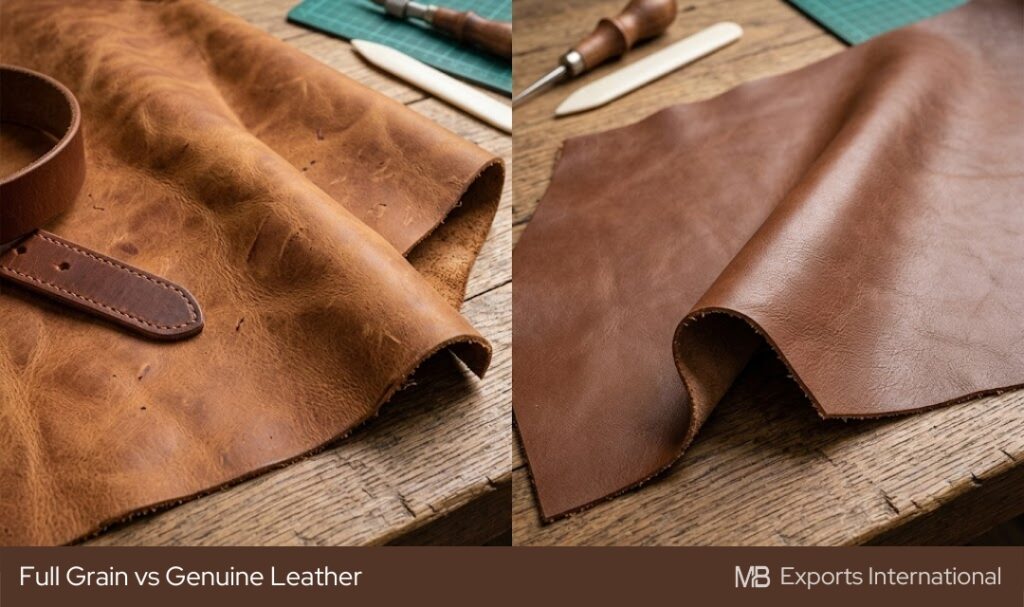
Full grain leather is the top layer of the hide, left untouched. No sanding, no buffing, no removing the natural surface.
Because the natural grain stays intact, you get a few real benefits:
- It’s the strongest and most durable layer of the hide
- It breathes, since the natural pores haven’t been sanded away
- It develops a patina, that rich, darkened look you see on old leather boots or a worn-in belt
- Every piece looks a little different, because it’s showing the real texture of the animal’s skin
The catch: it’s not perfectly smooth. You’ll see small marks, slight texture variation, maybe a faint scar line here and there. That’s not a flaw. That’s proof nobody sanded away the good part.
It also costs more. Full grain leather is the best material a tannery has, so naturally it’s priced like it.
Full grain leather meaning, in plain terms: the strongest, most natural layer of leather, sold exactly as nature made it.
What Is Top Grain Leather
Top grain is the second cut. Tanneries take the same top layer used for full grain, but this time they sand off the surface to remove imperfections and even out the texture.
What that sanding does:
- Removes the natural grain pattern, along with the tightest fiber layer
- Lets the tannery emboss a fake, perfectly uniform texture onto the surface
- Makes the leather thinner, softer, and easier to work with
- Costs less than full grain
You’ll see top grain leather in a lot of mid-range bags and jackets. It looks clean and consistent on a shelf. But it won’t age the way full grain does, and it’s noticeably less durable since the strongest fiber layer is gone.
If full grain is the unedited photo, top grain is the filtered version. Looks nice, missing some of what made the original good.
What Is Genuine Leather
This is where it gets misleading. “Genuine leather” sounds like a quality stamp. It’s actually the opposite.
Genuine leather is made from the lower layers of the hide, the leftover material after the good top layers have been sliced off for full grain and top grain products. It’s still real leather (not plastic, not vinyl), but it’s the weakest, least durable layer available.
To make it usable, manufacturers usually:
- Sand or buff the surface
- Coat it with a finish or stamp on a fake texture
- Sometimes glue together scraps to form a usable sheet (called bonded leather, a step below even this)
Is genuine leather real leather? Yes. Is it good leather? No, not really.
It’s the most affordable option, which is exactly why low-cost brands use the term. “Genuine leather” sounds reassuring on a tag, even though it’s telling you this is the bottom of the barrel.
Full Grain Leather vs Genuine Leather: Side by Side
| Full Grain | Genuine Leather | |
|---|---|---|
| Hide layer used | Top layer, untouched | Lower, leftover layers |
| Surface | Natural, unsanded | Sanded, often stamped with fake texture |
| Durability | Lasts decades | Wears out in a few years |
| Patina | Develops a rich patina | Doesn’t really develop one |
| Breathability | High | Low |
| Price | Highest | Lowest |
| Best for | Items you want to keep for years | Budget items, short-term use |
If you’re buying something you’ll carry every day for the next 10 years, full grain is worth the price difference. If you need something cheap for a season, genuine leather will do the job and nothing more.
A Quick Way to Tell Them Apart in a Store
You don’t need to be an expert to spot the difference. Run your hand across the surface:
- Full grain feels slightly uneven, with visible texture, small marks, and natural grain. It also smells distinctly like leather.
- Top grain feels smoother and more uniform, almost too perfect. The texture often repeats in a pattern, which is your giveaway that it’s embossed rather than natural.
- Genuine leather usually feels stiff or plasticky on the surface, with a texture that looks identical across the whole piece, because it’s stamped on, not natural.
If the tag just says “leather” with no mention of “full grain” or “top grain,” assume it’s genuine leather or lower.
Which One Should You Actually Buy
Depends on what you need:
- Buying a wallet, belt, or bag you want to last years and look better with age? Get full grain.
- Want something that looks polished and uniform, on a moderate budget? Top grain works.
- Need something cheap for short-term use, not fussed about longevity? Genuine leather is fine, just know what you’re getting.
The only real mistake is paying full grain prices for something that’s actually genuine leather. Read the label carefully, and when in doubt, ask the seller directly which layer of the hide it’s made from.
About MB Exports
At MB Exports, we manufacture and export genuine full grain and top grain leather goods from India. We’re upfront about which layer of leather goes into every product we make, because that’s the only way a customer can actually trust what they’re buying.
Get in touch with our team if you’re sourcing leather goods for your brand and want full transparency on materials.