Most people pick up a leather bag, feel the surface, and decide whether it looks nice. That tells you almost nothing about whether it will hold up.
We manufacture leather bags. Here is exactly what we check before anything leaves our facility, and what you should check before you buy or source from anyone.
1. The Leather Grade
Everything else depends on this. The grade of leather used determines how the bag ages, how long it lasts, and whether it looks better or worse five years from now.
Full grain leather is the top layer of the hide, untouched. Tight fibre structure, develops a patina, lasts decades. This is what quality looks like.
Top grain leather has been sanded smooth and refinished. Still real leather, still durable. Most mid to high range bags use this.
Genuine leather is the lower layers of the hide. Real leather, weak fibres, noticeably shorter lifespan. Fine for budget goods, not for anything you plan to use daily.
Bonded leather or PU peels within 2 to 3 years. Avoid both for any serious daily-use bag.
How to check: ask the seller directly which grade it is. If they cannot answer or deflect with vague terms like “premium leather” or “high quality leather,” that is your answer.
2. The Stitching
Stitching is what holds the bag together. It is the single biggest indicator of construction quality and the first thing we look at on any bag coming off the line.
What good stitching looks like:
- Even stitch length throughout, no variation
- Straight lines with no wandering
- Consistent thread tension, no puckering or pulling on either side
- No loose threads or fraying ends anywhere
- Backstitch at the start and end of every seam
Red flags:
- Uneven stitch spacing
- Thread poking through the wrong side of the leather
- Any seam that looks like it was stitched in a hurry
- Loose thread ends that have been cut but not sealed
Pay extra attention to handle attachment points and base corners. These take the most load. If the stitching is cut or loose anywhere near these areas, the bag will fail there first.
3. The Hardware
Cheap hardware ruins good leather. We see this regularly: well-made bags that are let down by zinc alloy buckles that corrode within a year.
Solid brass hardware is the benchmark. Heavy, doesn’t corrode, doesn’t tarnish badly, keeps its finish over years of use. You can tell brass from zinc by weight: brass feels noticeably heavier in your hand.
Zinc alloy (zamak) is the cheap alternative. Lighter, slightly hollow-sounding when tapped, and will corrode or snap under regular stress.
What to check:
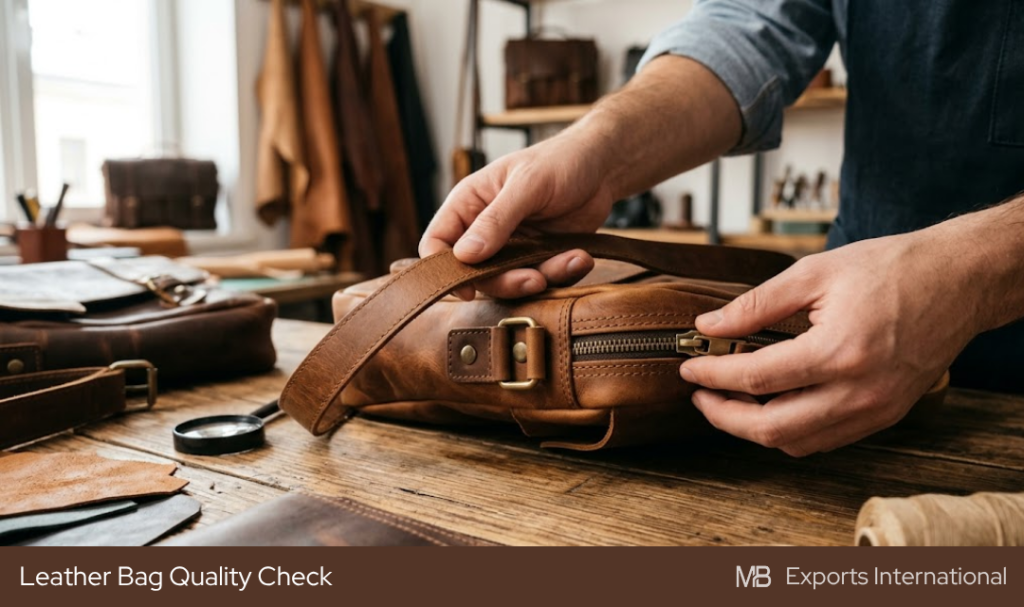
- Open and close every zipper at least three times. It should run smoothly without catching or requiring force.
- Test every clasp, buckle, and magnetic closure. They should snap firmly and stay closed.
- Pull D-rings and swivel clips in the direction they will be loaded. They should not flex or bend.
- Look at where hardware attaches to leather. Rivets should be flush and tight. Stitching around hardware attachment points should be double-stitched.
4. Edge Finishing
The edges of a leather bag are where shortcuts show up fastest. A clean edge means someone took the time to finish it properly. A rough or peeling edge means they didn’t.
Good edge finishing looks like:
- Burnished edges, smoothed down and sealed with edge paint or beeswax
- A clean, consistent edge colour that matches or complements the leather
- No rough fibre poking out on cut edges
- No adhesive residue visible at the edge line
What bad finishing looks like:
- Raw, rough fibrous edges left unsealed
- Thick globs of edge paint applied unevenly
- Peeling edge coating that’s already lifting on a new bag
Run your thumb across the top edge of the bag and along any strap edges. If it catches, scratches, or feels rough, the finishing is poor.
5. Stress Points and Reinforcement
Stress points are where bags fail. Handle attachment points, zipper ends, D-ring attachments, base corners. A quality bag reinforces every one of these.
What to look for:
- Double or triple stitching at handle attachment points
- Metal rivets in addition to stitching at high-stress areas
- A leather gusset or reinforced patch where straps meet the bag body
- Reinforced base corners, either with metal feet, stitched corner guards, or thicker leather panels
Pick up the bag by its handles and apply moderate pressure. The attachment points should not flex, pull, or show any signs of stress. If they do on an empty bag, they will fail quickly under real load.
6. The Lining
The lining is what most buyers ignore. It’s also where brands cut costs most easily.
A quality lining is made from canvas, suede, or a durable fabric that holds its shape and does not fray at seams. A cheap lining is thin polyester that pills, tears, and detaches from the leather shell within a year.
Check the lining by:
- Feeling the interior fabric. It should feel substantial, not flimsy.
- Looking at the interior seams. They should be clean, not fraying.
- Checking where the lining meets the leather shell at the top edge. It should be cleanly bonded and stitched, not just glued loosely.
- Opening every interior pocket and checking the pocket stitching. This is where lining quality issues show up fastest.
7. Structure and Shape Retention
A good leather bag holds its shape. It does not collapse when empty or slump to one side under load. This comes from the leather grade, the internal structure, and the pattern cutting.
To test this:
- Put the empty bag down on a flat surface. It should sit upright or in its intended position without needing support.
- If it has a structured base, press on it from the top. It should resist and spring back.
- Open the bag fully and look at the interior walls. There should be no buckling, creasing in the wrong places, or areas where the leather has been poorly cut and is pulling.
Soft bags like totes and bucket bags are meant to have some give. Structured bags like briefcases and satchels should have virtually none.
8. The Overall Finish
Stand back and look at the bag as a whole. Quality bags have a consistency to them: even colour, matched seams, hardware sitting straight, all panels aligned.
Signs of a quality finish:
- Colour is even across the whole surface with no patchy or thin areas
- All panels are aligned where they join, no mismatched seams
- Hardware sits straight, not slightly off-center
- The bag smells like real leather, not chemicals or plastic
- Any logo or branding is applied cleanly and sits flush
Signs of a poor finish:
- Uneven dye coverage or visible brush marks
- Panels that do not align at seams
- Hardware that sits crooked or moves when pressed
- Visible glue residue anywhere on the exterior
A Note on Samples (For B2B Buyers)
If you are sourcing leather bags in bulk from a manufacturer, the sample stage is your quality check window. Everything above applies to every sample you receive.
Be especially strict about stitching consistency and hardware quality on samples, because these are the areas manufacturers sometimes tighten up on samples and loosen on production runs. Ask for a production sample, not a one-off handmade prototype, before committing to volume.
At MB Exports, we produce production-matched samples. What you approve is what goes into the order.
About MB Exports
At MB Exports, we manufacture and export leather bags and accessories from India. Every item goes through these same quality checks before it ships. We work with full grain and top grain leather and are transparent about materials, construction, and lead times.
If you are sourcing leather goods for your brand and want a manufacturer who builds quality in rather than inspecting it out at the end, get in touch with our team.