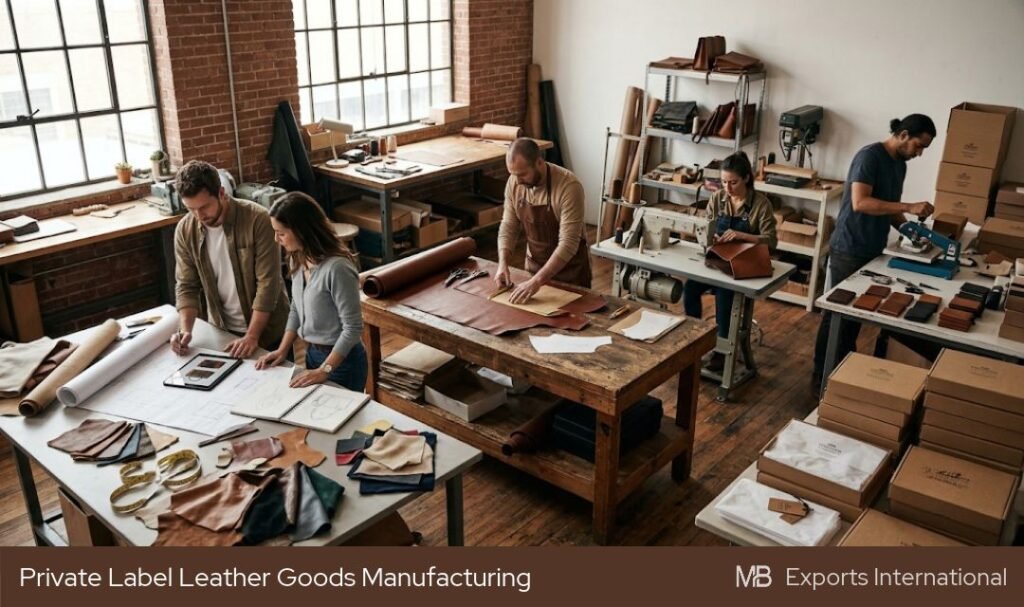
Private label means a factory makes the product and you sell it under your own brand. You skip the factory, the tannery, and the craftsmen. You focus on the brand, the customers, and the sales.
Simple idea. But the process has a few steps that trip up first-time buyers. Here’s how it actually runs, from first email to shipment.
If you’re not sure private label is the right model for you, read our private label vs white label vs OEM vs ODM guide first.
The 7 Steps of How Private Label Leather Goods Manufacturing Works
1. Decide what you’re making
Before you contact anyone, get clear on:
- Product: bags, wallets, belts, or accessories
- Leather: full grain, top grain, vegetable tanned, or chrome tanned
- Hardware: brass, antique brass, gunmetal, or silver
- Branding: embossed logo, metal plate, or woven label
- Target quantity and price
You don’t need a finished design. In private label you can start from the factory’s existing styles and change them. But the clearer your brief, the faster everything moves.
2. Pick a base design
Choose a style from the manufacturer’s catalogue, or share a reference photo of something close to what you want. This is your starting point.
Then tell us what to change. Most brands customize some mix of:
- Leather type and colour
- Hardware finish
- Size and proportions
- Lining colour
- Pockets and compartments
- Logo placement
A standard satchel in chrome-tanned black is one product. The same satchel in vegetable-tanned tan with antique brass and a contrast lining is a completely different product.
3. Get a quote
A proper quote covers unit price, MOQ, sample cost, and lead time, based on your exact specs. Send the same brief to every manufacturer you’re comparing, otherwise you’re comparing different products.
Watch out for: a quote that arrives instantly with no questions. A real manufacturer needs to know the leather, hardware, and quantity before pricing.
4. Sampling
This is the most important step. The sample shows you what bulk production will look like.
- Sampling usually takes 2 to 4 weeks
- Most manufacturers charge a sample fee, often credited against your bulk order
- Expect one or two rounds of changes
When your sample arrives, check the leather, stitching, hardware, edge finishing and dimensions against your brief. Our leather bag quality check guide walks through exactly what to inspect.
Be strict here. It costs almost nothing to fix a sample. It costs a lot to fix 300 finished bags.
5. Approve and place the order
Once you approve the sample, you confirm the order. Typically that means:
- A purchase order with the full specifications written down (leather grade, hardware, dimensions, colours)
- An advance payment, commonly 30% to 50%
- A confirmed delivery date
Put the leather grade and hardware material in the purchase order itself, not just in an email. This protects you from silent substitutions later.
6. Production and quality checks
Bulk production usually takes 4 to 8 weeks after approval. Special leathers, custom tanning, or custom hardware add time.
A good manufacturer checks quality at several points: after cutting, during stitching, and before packing. Ask for photos at each stage. For larger orders, a third-party pre-shipment inspection is cheap insurance.
7. Packing and shipping
Your branded packaging, dust bags, tags, and labels get packed with the goods. Most international orders ship FOB from an Indian port, by sea or air.
What You Need to Bring
You don’t need much, but you do need these:
| Item | Why it matters |
|---|---|
| Logo file (vector: AI, SVG or PDF) | For embossing, plates, labels |
| Brand colours | To match leather and thread |
| Leather and hardware preferences | Drives the quote |
| Quantity and budget | So you get a realistic quote |
| Packaging requirements | Boxes, dust bags, tags |
| Target launch date | So we can plan backwards |
MOQ: What’s Realistic
For leather goods, MOQs usually fall between 50 and 200 pieces per style, depending on the product and how much you customize. Bags with more components usually sit higher. Wallets and small accessories usually need higher quantities because they’re quick to make and setup time is the same.
Things that push MOQ up:
- Custom-dyed leather colours
- Custom-made hardware or moulds
- Multiple colour variants of one style
A tip that saves money: start with one or two styles and a smaller first order. Prove the product sells, then expand.
What It Costs
There’s no single number, because the cost depends on the leather, the construction, and the quantity. These are the main cost drivers:
- Leather grade and quantity (full grain costs more than top grain)
- Hardware (solid brass costs more than zinc alloy)
- Complexity (more panels, pockets and stitching mean more labour)
- Lining and finishing
- Branding (embossing is cheap, custom metal plates are not)
- Packaging and freight
Always ask for a quote broken down by these, so you can see where the money goes and where you can trim.
Four Mistakes That Cost New Brands the Most
- Treating a “free sample, no questions asked” offer as a good sign. If a supplier offers samples instantly with no development process, they’re often just putting your logo on ready-made stock. That’s white label, not private label.
- Skipping the written spec. “Good quality leather” means different things to different people. Write down the grade, thickness, hardware, and stitching.
- Approving a sample you’re not happy with. “We’ll fix it in production” almost never happens. Fix it at sample stage.
- Going too big on the first order. Start small, sell, then reorder. Leather goods are easier to scale than to unload.
About MB Exports International
At MB Exports International, we manufacture and export leather goods from India. We work with brands on private label orders from first brief through to shipment, and we’re upfront about leather grade, MOQs, and timelines from the first conversation.
Got a product in mind? Send us your brief and we’ll come back with a clear quote and next steps.