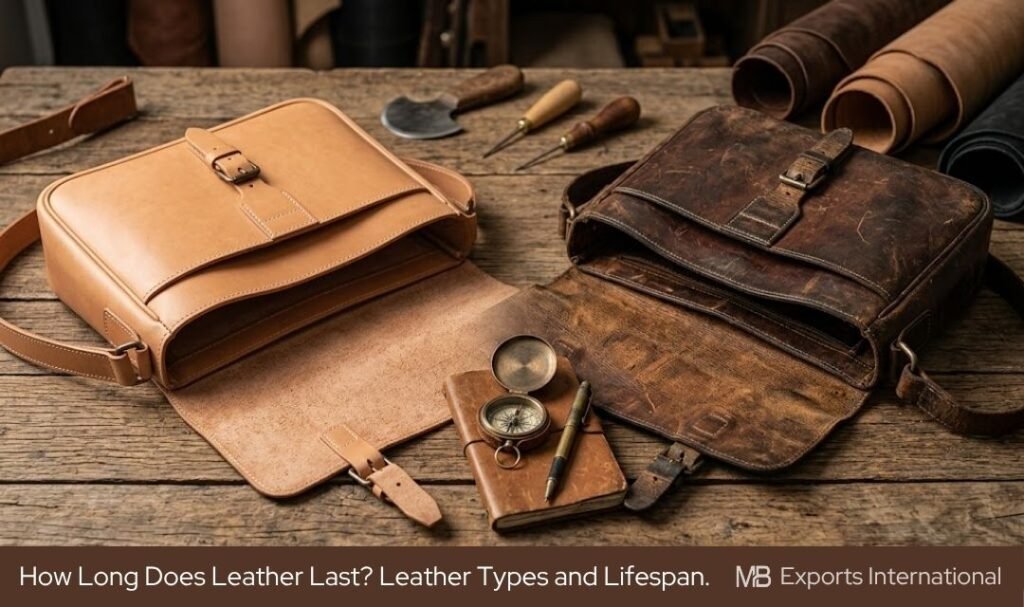
People ask us this more than almost any other question. And honestly, the answer depends entirely on what kind of leather you bought in the first place.
We manufacture leather goods. We see what holds up and what doesn’t, not just in the showroom but after years of use. Here’s the real picture.
The Short Answer
A well-made full grain leather bag, belt, or wallet, cared for properly, can last 20 to 30 years. Some pieces outlast their owners.
A poorly made piece of genuine leather or bonded leather might start showing wear in 12 to 18 months. The surface peels. The stitching fails. The structure collapses.
Same word on the label. Completely different lifespan.
How Long Each Type of Leather Lasts
Let’s understand t leather bag lifespan based on it’s leather type as this is the most important thing to understand.
1. Full grain leather: 20 to 30+ years
The strongest, most durable layer of the hide. Nothing has been sanded away, so the fibre structure is completely intact. With basic care, conditioning once or twice a year and keeping it away from prolonged moisture, full grain leather does not just survive, it improves. The patina it develops over decades is something no new bag can replicate.
We have seen full grain leather belts and bags come back to us that are 15 to 20 years old and structurally sound. The leather itself is fine. What usually fails first is the hardware.
2. Top grain leather: 10 to 20 years
The surface has been sanded and refinished, which removes the tightest fibre layer. Still real leather, still durable, but slightly more prone to cracking at stress points over time. With regular conditioning it holds up well for a decade or more.
3. Genuine leather: 3 to 5 years
Made from the lower layers of the hide, the loosest fibres, so it’s inherently weaker than full grain or top grain. It is still real leather, but it will show wear significantly faster. The surface dulls, edges start peeling, and stress points fail earlier.
4. Bonded leather: 1 to 3 years
Not really leather in the traditional sense. Ground-up scraps and fibres pressed together with adhesive. The polyurethane coating that makes it look like leather starts cracking and flaking within a couple of years of regular use. Once it starts, there is no saving it.
5. PU leather: 2 to 4 years
Pure synthetic. Looks great on day one, starts peeling at fold points and corners within a few years. The cheaper the construction, the faster it goes.
Leather Bag Lifespan: What Actually Fails First
After years of manufacturing leather goods, here is what we consistently see fail before the leather itself:
- Stitching. Cheap thread with insufficient stitching density. The leather panel is fine but the seam splits. This is why saddle stitching with waxed linen or polyester thread outlasts machine-locked stitching. If one stitch breaks in a saddle-stitched seam, the rest holds. In a machine lockstitch, the whole seam can unravel.
- Hardware. Zippers, clasps, D-rings, and buckles. Cheap zinc alloy hardware corrodes, bends, or snaps. Solid brass hardware lasts as long as the leather. This is one area where the difference between a cheap bag and a quality one is immediately visible.
- Handle and strap attachment points. These take the most load. Thin, poorly reinforced attachment points fail under daily weight long before the leather body wears out. Quality construction uses rivets, reinforced leather patches, and double stitching at these points.
- The lining. Canvas or fabric linings often fail before the outer leather. Check the lining quality when buying. A bag with a good exterior and a cheap lining will still feel worn out and unpleasant to use within a few years.
Signs Your Leather Is Starting to Wear
Leather tells you when it needs attention before permanent damage sets in:
- Surface looks dry, dull, or slightly grayish where it used to have depth
- Small surface cracks appearing, especially at fold lines and corners
- Stiffness in areas that used to be supple
- Stitching starting to fray or loosen at stress points
- Hardware feeling loose or showing surface corrosion
None of these are death sentences for the piece. Catch them early and most can be fixed. Dry leather can be reconditioned. Loose stitching can be resewn. Tarnished brass can be polished. The only thing that truly ends a leather piece is letting these warning signs go unaddressed for too long.
How to Get Maximum Life from Leather
From a manufacturer’s perspective, here is what actually works:
- Condition it. Once every three to six months for regular use. More often in dry or hot climates. A good leather conditioner penetrates the fibres and keeps the hide supple. This is not optional maintenance, it is the single most impactful thing you can do.
- Keep it dry. If your leather bag gets wet, empty it, stuff it with newspaper to hold the shape, and let it dry naturally away from heat. Never use a hairdryer or leave it near a radiator. Rapid drying causes fibres to contract unevenly and crack.
- Do not overload it. Constant overpacking stresses the stitching, deforms the structure, and stretches the leather at handle attachment points. Use a bag sized for what you actually carry.
- Store it properly. When not in use, stuff it lightly to maintain its shape. Keep it in a breathable cotton bag, not plastic. Plastic traps moisture and encourages mold.
- Address damage early. A small scratch, a loose stitch, a slightly worn edge, these are all fixable. Left alone, they become unfixable.
About MB Exports
At MB Exports, we manufacture and export leather goods from India. We work with full grain and top grain leather because those are the only grades we are confident enough to put our name on.
If you are sourcing leather goods for your brand and want to know exactly what goes into the products before you order, get in touch with our team.