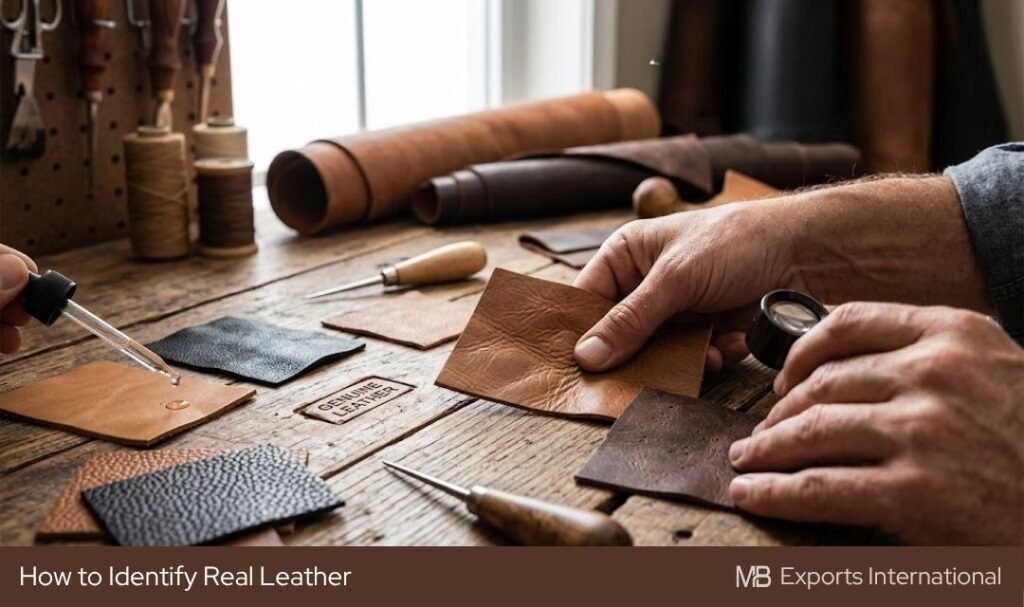
You pick up a bag. The label says leather. But something feels off.
Here is how to know for certain, before you spend your money.
1. Read the Label First
Start here. It takes two seconds and tells you most of what you need to know.
Real leather labels say: “full grain leather,” “top grain leather,” “genuine leather,” “100% leather.”
Fake leather labels say: “PU leather,” “faux leather,” “vegan leather,” “synthetic leather,” “leatherette,” “man-made material.”
If the label says “leather” with no qualifier, or avoids the question entirely, treat it as a red flag. A brand using real leather has every reason to say so clearly.
2. The Smell Test
Real leather has a distinct earthy, animal smell. It is impossible to fake convincingly.
Fake leather smells like plastic, chemicals, or nothing at all. High-end PU can be odourless, but it will never smell like real hide.
Get close and smell it. If you smell plastic, you have your answer.
3. The Surface Test
Look at the grain closely.
Real leather has an irregular, natural grain pattern. No two sections look identical. You will see slight variations, small pores, faint marks. That inconsistency is proof it came from an actual animal.
Fake leather has a perfectly uniform, repeating grain pattern. It looks too consistent because it is machine-stamped. The closer you look, the more the pattern repeats like wallpaper.
4. The Touch Test
Run your hand across the surface.
Real leather feels warm to the touch and warms with your body heat within a few seconds. It has a slight give and a natural texture that is neither perfectly smooth nor perfectly rough.
Fake leather feels cool or room temperature and stays that way. It feels slightly plasticky or waxy. You can usually feel the fabric weave underneath if you press firmly.
5. The Edge Test
This one is one of the most reliable and most overlooked.
Look at the cut edges of the piece, inside seams, the top of a wallet, the bottom of a bag strap.
Real leather has a rough, fibrous edge. You can see the actual fibres of the hide where it was cut. It looks organic and slightly uneven.
Fake leather has a clean, perfectly smooth edge, or shows a fabric backing underneath. Because it is a manufactured sheet bonded to fabric, the edge cuts cleanly like plastic.
If you can see a woven backing behind the surface layer, it is not real leather.
6. The Bend Test
Pick up a piece and bend or fold it in your hand.
Real leather bends naturally, slightly changes colour at the fold, and wrinkles like skin. It springs back but leaves a subtle crease. This is the natural behaviour of tightly packed collagen fibres.
Fake leather resists bending or feels stiff and plastic-like. When you release it, it snaps back rigidly without any natural crease. Some cheap PU will crack or crease permanently at the fold point.
7. The Water Test
Put a few drops of water on the surface.
Real leather absorbs moisture. The water will darken the surface slightly and disappear within 10 to 30 seconds as the hide absorbs it. This is why leather needs conditioning: it takes in moisture and oils from the environment.
Fake leather repels water. The drops will bead up and sit on the surface until you wipe them off.
This test is also why real leather needs care and fake leather does not. Absorption is a feature of real hide, not a weakness.
One More Thing: Price Is a Signal
Real leather costs more to produce. Always. If a bag or wallet is priced suspiciously low and the brand is calling it leather, at least one of the tests above will catch it.
This is not to say expensive automatically means real. But if something claims to be full grain leather and costs less than a decent lunch, something does not add up.
What About “Genuine Leather”? Is That Real?
Yes, it is real animal hide. But it is the lowest grade, made from the leftover lower layers of the hide after the quality top layers have been cut away for full grain and top grain products.
It passes all seven tests above. It is real leather. It is also the weakest, least durable version of real leather available.
If a brand is using “genuine leather” as a selling point rather than a disclosure, that is worth noting. Real leather manufacturers who use full grain or top grain do not hide behind the word “genuine.”
For a full breakdown of leather grades, read our Full Grain vs Genuine Leather guide.
About MB Exports
At MB Exports, we manufacture and export genuine leather goods from India. We use full grain and top grain leather and are always transparent about what goes into our products, because buyers who know their leather deserve straight answers.
Get in touch with us if you are sourcing leather goods for your brand.