Here’s something that happens constantly in the leather industry. A buyer reaches out to what they think is a factory, places an order, and three months later receives goods that look nothing like the sample. Why? Because the “manufacturer” they found was actually a trading company placing the order with someone else.
This is one of the most common and expensive sourcing mistakes in leather goods. Understanding the difference between a manufacturer, a supplier, and a wholesaler fixes it before it costs you money.
The Manufacturer
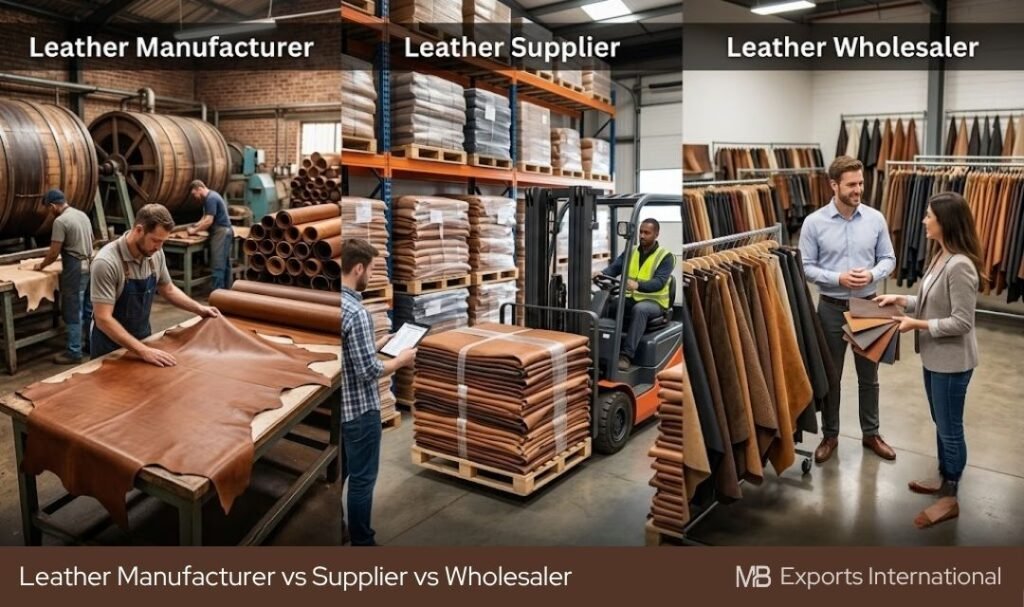
A manufacturer makes the product. They own or operate the production facility, buy raw materials (hides, thread, hardware), employ the craftsmen, and control every stage from cutting to stitching to finishing.
When you work directly with a manufacturer:
- You get factory-direct pricing with no middleman margin on top
- You can customise products, request private labelling, and adjust specifications
- You have visibility into the actual production process
- Quality issues can be caught and corrected before goods ship
- Lead times are based on real production capacity, not a third party’s schedule
The tradeoff is that manufacturers usually have minimum order quantities (MOQs). They are running a production line, not a shop. A one-off order of five bags does not make commercial sense for a factory set up to produce hundreds.
The Supplier
“Supplier” is the most loosely used word in B2B sourcing. It can mean anything.
A supplier might be:
- A manufacturer who also sells directly (in which case, great)
- A trading company that places your order with a manufacturer and takes a margin for the service
- An export house that aggregates products from multiple small factories
- An agent who connects buyers with factories for a commission
None of these are inherently bad. But you need to know which one you are dealing with, because the implications for price, quality control, and customisation are completely different.
A trading company acting as a supplier will mark up the factory price, sometimes by 20% to 40%. They may not have direct quality control at the production level. And when something goes wrong, you are dealing with a middleman who is dealing with a factory, not the factory itself.
How to tell if you are talking to a real manufacturer or a trading company:
- Ask to visit the factory or request a virtual factory tour
- Ask for production photos at different stages, not just finished product shots
- Check if they can make real-time changes to an in-progress order
- Ask what their in-house capacity is in units per month
- A real manufacturer can answer all of these without hesitation
The Wholesaler
A wholesaler buys finished goods in bulk from manufacturers and resells them to retailers or brands. They carry stock, which is their main advantage. You can order smaller quantities and receive goods faster because the production is already done.
The tradeoff: no customisation. You are buying what they have. Colours, sizes, styles are fixed. No private label, no logo, no design changes.
Wholesalers work well for:
- Brands that need fast replenishment of standard styles
- Smaller buyers who cannot meet a manufacturer’s MOQ
- Businesses testing a new product line before committing to custom production
They do not work well if you are building a brand, need any level of product differentiation, or care about factory-direct pricing.
Side by Side
| Manufacturer | Supplier (Trading Co.) | Wholesaler | |
|---|---|---|---|
| Makes the product | Yes | No | No |
| Factory-direct pricing | Yes | No (markup added) | No (markup added) |
| Customisation and private label | Yes | Sometimes | Rarely |
| MOQ | Higher | Medium | Lower |
| Quality control | Direct | Limited | None |
| Lead time | Based on production | Dependent on factory | From existing stock |
| Best for | Brands and bulk buyers who want control | Buyers who need local handling or smaller runs | Fast reorders of standard styles |
Working Directly with a Manufacturer: What to Expect
If you decide to source factory-direct, here is what the process typically looks like:
- Sampling: You share your design, specifications, and leather requirements. The manufacturer produces samples for your approval. This takes 2 to 4 weeks typically and may involve a sample fee, which is often credited against the bulk order.
- MOQ negotiation: Most genuine leather manufacturers in India start MOQs at 50 to 200 pieces per style depending on complexity. Custom hardware or exotic leathers push this higher.
- Production lead time: Once the sample is approved and the advance payment is received, production typically takes 4 to 8 weeks. Custom tanning or special finishes add time.
- Quality check: A reputable manufacturer does in-line inspection during production and a final inspection before packing. International buyers often request third-party inspection before shipment.
- Export documentation: A proper export manufacturer handles all documentation including commercial invoice, packing list, certificate of origin, and bill of lading. This should not be your problem to manage.
About MB Exports
At MB Exports, we are a manufacturer and exporter of leather goods based in India, not a trading company, not a wholesaler. We own our production process, which means when you place an order with us, you are dealing directly with the people making your product.
If you are an international buyer looking for factory-direct leather goods with full customisation and private label capability, get in touch with our team.