If you’ve ever ordered leather and received something that felt completely wrong for your project, thickness is usually the reason.
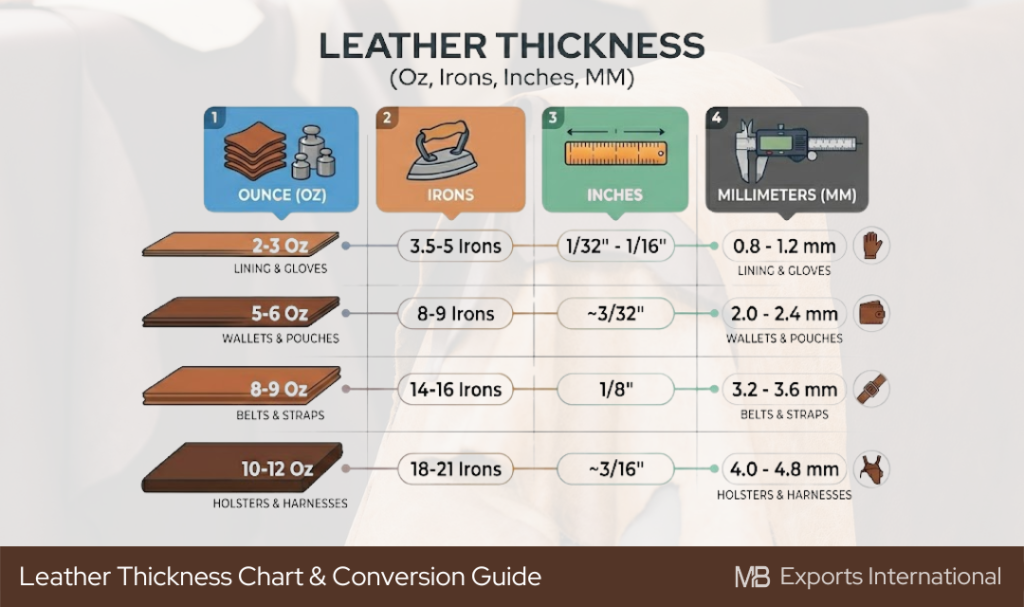
Leather weight gets listed in ounces (oz) in the US, irons in the UK, or millimetres (mm) everywhere else. The conversion is simple: 1 oz = 0.4 mm. But knowing which thickness works for which project? That’s what this guide is for.
Leather Thickness Chart (Oz, Irons, Inches and MM)
| Weight (oz) | Irons | Fractional Inches | Decimal Inches | Thickness (mm) | Common Applications |
|---|---|---|---|---|---|
| 1 oz | 0.75 | 1/64″ | 0.016″ | 0.41 mm | Leather linings, wallet interiors, watch strap linings, lightweight garment panels |
| 2 oz | 1.50 | 1/32″ | 0.031″ | 0.78 mm | Soft pouches, purse linings, shoe uppers, fashion accessories |
| 3 oz | 2.25 | 3/64″ | 0.047″ | 1.19 mm | Wallet exteriors, notebook covers, lightweight bags, small leather goods |
| 4 oz | 3.00 | 1/16″ | 0.063″ | 1.60 mm | Handbags, pouches, boot shafts, aprons, lightweight knife sheaths |
| 5 oz | 3.75 | 5/64″ | 0.078″ | 1.98 mm | Structured handbags, tool pouches, chaps, medium-duty sheaths |
| 6 oz | 4.50 | 3/32″ | 0.094″ | 2.39 mm | Work aprons, utility pouches, footwear components, protective covers |
| 7 oz | 5.25 | 7/64″ | 0.109″ | 2.78 mm | Heavy pouches, outdoor gear, axe sheaths, reinforced leather accessories |
| 8 oz | 6.00 | 1/8″ | 0.125″ | 3.18 mm | Everyday belts, dog collars, holsters, straps, saddlebags |
| 9 oz | 6.75 | 9/64″ | 0.141″ | 3.58 mm | Premium belts, bridles, halters, scabbards, tool holders |
| 10 oz | 7.50 | 5/32″ | 0.156″ | 3.96 mm | Heavy-duty belts, stirrup straps, livestock tack, industrial strap goods |
| 11 oz | 8.25 | 11/64″ | 0.172″ | 4.37 mm | Gun belts, cattle halters, heavy leads, load-bearing straps |
| 12 oz | 9.00 | 3/16″ | 0.188″ | 4.78 mm | Work belts, equestrian equipment, rugged utility harness components |
| 13 oz | 9.75 | 13/64″ | 0.203″ | 5.17 mm | Heavy harness parts, draft-animal tack, premium saddle components |
| 14 oz | 10.50 | 7/32″ | 0.219″ | 5.57 mm | Saddle skirting, machine belting, stirrup leathers, industrial applications |
| 15 oz | 11.25 | 15/64″ | 0.234″ | 5.95 mm | Heavy harnesses, saddle skirts, boot soles, leather heels |
| 16 oz | 12.00 | 1/4″ | 0.250″ | 6.36 mm | Work harnesses, saddle skirting, outsole leather, high-stress industrial uses |
Does Tanning Method Affect How Thickness Feels?
Yes, and this is something buyers often miss.
Same weight, different feel. A 5 oz vegetable-tanned hide will feel noticeably stiffer than a 5 oz chrome-tanned hide, even though both measure the same on a gauge. Chrome-tanned leather is softer and more pliable at the same weight.
This matters for your project:
- Vegetable-tanned leather at 4 to 6 oz is firm enough for structured wallets, belts, and holsters straight off the roll. It also takes tooling and carving.
- Chrome-tanned leather at 4 to 6 oz is better suited for bags, upholstery, and garments where softness and drape are needed.
If tooling or carving is part of the design, veg tan is the only option regardless of thickness. Chrome-tanned leather does not hold impressed designs.
A Note on Natural Variation
A single hide will not be exactly the same thickness from end to end. The thickest part is usually along the backbone, and the thinnest sections are around the belly and legs. When a supplier quotes “5 oz leather,” that is the range for the prime usable area of the hide.
A natural variation of plus or minus 0.2 mm across a piece is completely normal. For projects where consistent thickness is critical (watch straps, precision-cut wallets, machine-stitched belts), specify a tight tolerance when ordering, or ask whether the hides have been split or shaved to a uniform gauge.
Can Leather Be Thinned After Tanning?
Yes. The process is called skiving. A skiver removes material from the flesh side of the leather to reduce thickness without touching the grain surface. It is standard practice for edge thinning before folds, and it is also done across full panels when a supplier needs to hit a specific thickness the raw hide does not match exactly.
If you are manufacturing finished goods at volume, ask your leather supplier whether skiving is available as part of the prep process.
Sourcing Leather at the Right Thickness
When placing a bulk order with a leather manufacturer, always specify:
- Thickness in mm (more precise than oz for international orders)
- Acceptable tolerance, typically plus or minus 0.2 mm
- Whether uniform thickness across the full piece is required or if natural variation is acceptable
- Tanning method, since it affects stiffness at the same weight
- Whether skiving or splitting is needed as part of the prep
Getting these details confirmed in writing before production starts saves significant back-and-forth once the hides are cut.
About MB Exports
At MB Exports, we manufacture and export leather goods from India worldwide, working with both vegetable-tanned and chrome-tanned leather across the full thickness range. Whether you are sourcing finished goods or need guidance on which leather specification suits your product, we are happy to help.
Get in touch with our team for bulk leather sourcing, custom manufacturing, or general questions about leather specifications.