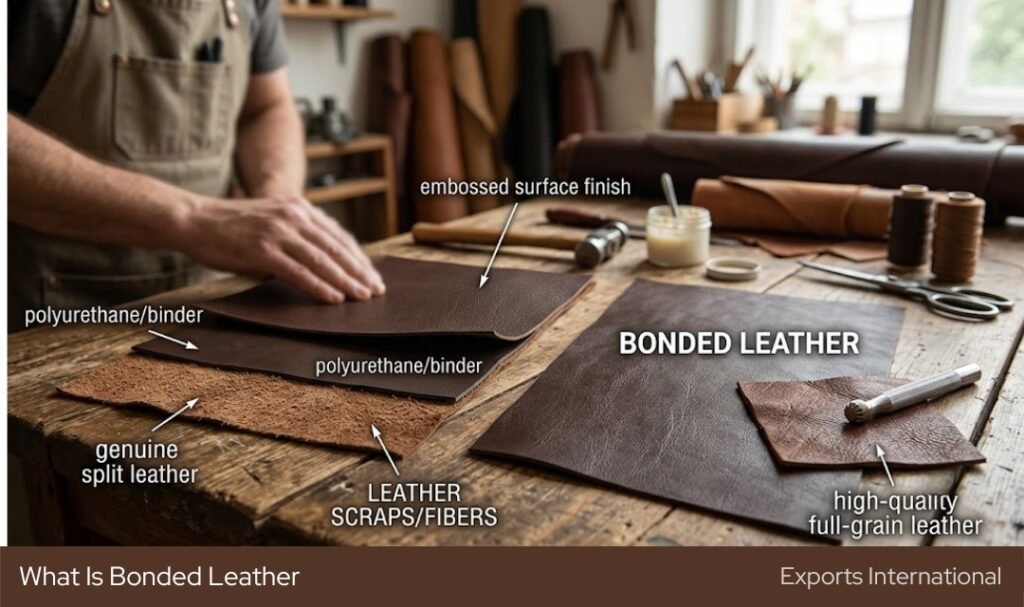
If you have bought a sofa, a wallet, or a notebook cover in the last decade and seen the word “leather” on the label, there is a decent chance what you got was bonded leather. It looks like leather. It’s sold as leather. But it is not really leather in any meaningful sense.
Here’s what it actually is.
Bonded Leather Meaning
Bonded leather is made from leftover leather scraps and fibres, the offcuts and shavings from real leather production that would otherwise go to waste. These scraps are ground up, mixed with a polyurethane or latex binder, and pressed onto a fibre or paper backing. The surface gets a polyurethane coating stamped with a grain texture to make it look like real leather.
Think of it like particle board. Real wood scraps bonded together with adhesive and pressed into a sheet. It looks like wood from a distance, but behaves nothing like solid timber.
Bonded leather is the particle board of the leather world.
The actual leather content in a piece of bonded leather can be anywhere from 10% to 90% depending on the manufacturer. There is no standard. Most of the time you have no way of knowing how much is in there.
Why Brands Use It
Simple: it costs almost nothing to produce.
The scraps used to make bonded leather are the material nobody wants. Turning them into a sheet that can be marketed as “leather” is extremely profitable. The word “bonded” sounds premium, the surface looks the part on a store shelf, and most buyers do not know the difference until months later when it starts peeling.
You will find bonded leather on budget furniture, cheap wallets, office chairs, notebooks, and steering wheel covers.
Bonded Leather vs Genuine Leather
This is where it gets confusing, because “genuine leather” sounds like a compliment. It is not. Genuine leather sits near the bottom of the leather quality hierarchy. But it is still real leather, and it still significantly outperforms bonded leather.
| Bonded Leather | Genuine Leather | |
|---|---|---|
| What it actually is | Ground leather scraps glued onto a backing | Real animal hide, lower layers of the hide |
| Real leather content | 10% to 90%, no standard | 100% real hide |
| Surface | Polyurethane coating with stamped grain | Sanded and finished, sometimes coated |
| Durability | 1 to 3 years before peeling | 5 to 10 years with basic care |
| Patina | None | Minimal, but more than bonded |
| Repairability | Cannot be repaired once peeling | Can be conditioned and maintained |
| Smell | Plastic or chemical | Faint natural leather smell |
| Price | Cheapest | Low to mid range |
| Best for | Disposable or short-term use | Budget items with some longevity |
Should You Ever Buy Bonded Leather?
If the price is low and you know what you are getting, it can make sense for short-term use. A cheap notebook cover. A prop. Something you need for a season and do not mind replacing.
What you should never do is pay genuine leather prices for bonded leather, which unfortunately happens more than it should. Some brands are deliberately vague about materials, using phrases like “premium leather blend” or “crafted from leather fibres” to obscure the fact that what you’re getting is the bottom of the barrel.
Read the label. Ask the question. And if they cannot tell you clearly what type of leather it is, that is your answer.
About MB Exports
At MB Exports, we manufacture and export genuine leather goods from India. We work with full grain and top grain leather and are always transparent about what goes into every product we make.
If you are sourcing leather goods for your brand and want a manufacturer who does not cut corners on materials, get in touch with us.