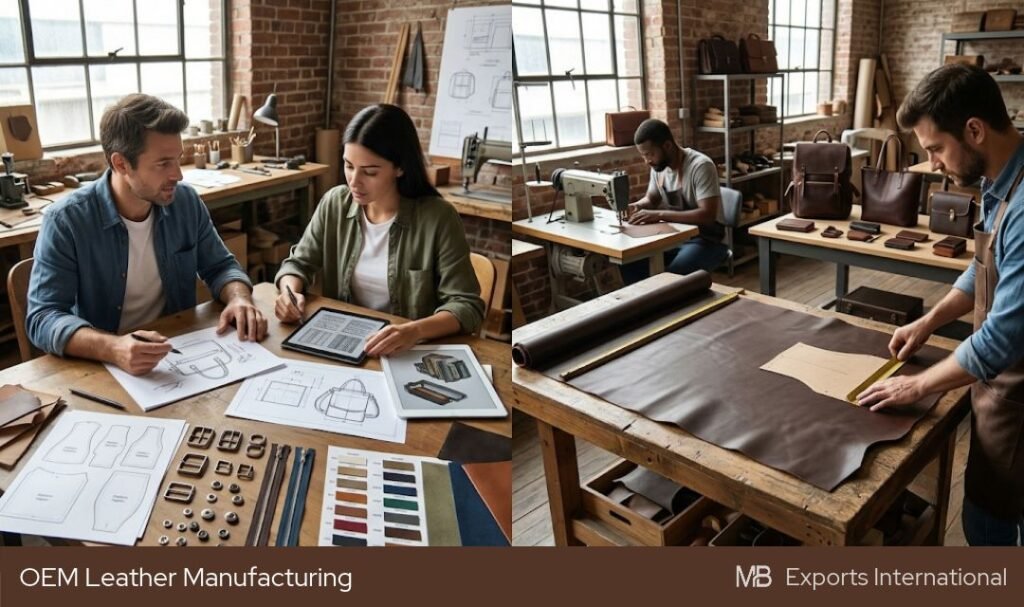
OEM means you design it and the factory builds it. You bring the design. We bring the leather, the craftsmen, the machines, and the quality control.
It’s the right model when you know exactly what you want and don’t want anyone else selling it. It’s also the model where the most things can go wrong if you’re not prepared.
Here’s how it works, who owns what, and what to have ready.
OEM in One Line
You own the design. The factory follows your specifications exactly.
That’s the difference from private label, where you start from the factory’s design and modify it. With OEM, the starting point is your design.
If you’re still deciding between models, read our private label vs white label vs OEM vs ODM guide.
What You Bring and What We Make
| You bring | We make |
|---|---|
| Tech pack (drawings, dimensions, specs) | Pattern and cutting dies from your design |
| Leather and hardware requirements | Sourcing of the leather, hardware, thread and lining |
| Logo and branding files | Branding applied exactly where you specify |
| Packaging requirements | Samples, then bulk production |
| Target quantity, price and timeline | In-line quality checks and final inspection |
| Approval at each sample stage | Packing and export documentation |
The more complete your side of this table, the fewer sample rounds you need.
What Goes in Your Tech Pack
A factory executes. It doesn’t guess. In OEM, the tech pack is the minimum, not an optional extra.
Include:
- Technical drawings: front, back, side, inside, and key details
- Dimensions: every measurement, including strap length and handle drop
- Leather: type (full grain or top grain), tanning, thickness, colour
- Hardware: type, size, finish (brass, antique brass, gunmetal)
- Lining: material and colour
- Stitching: thread, stitch length, reinforcement points
- Construction notes: how panels join, edge finishing, pocket details
- Branding: logo type and exact placement
- Packaging: tags, dust bags, boxes
Not sure about leather thickness? Our leather thickness chart helps you pick the right weight for each part of the bag.
No tech pack yet? Read how to build one in our guide to starting a leather bag brand. A vague brief means a sample that misses the mark and extra rounds you’ll pay for.
The OEM Process, Step by Step
1. Share your brief under NDA. Sign an NDA before you send the tech pack (more on this below).
2. Tech pack review. The factory checks it for gaps and tells you what’s unclear or hard to build. This is a good test of the factory: a good one asks questions, a bad one just says yes.
3. Quote. Unit price, MOQ, sample cost, and lead time based on your exact specs.
4. Pattern and sample. The factory makes patterns and cutting dies, then produces your first sample. Expect one to three rounds of revisions. OEM usually takes more rounds than private label because the design is brand new.
5. Approval. You sign off on the final sample. This becomes the benchmark for bulk production.
6. Bulk production. Cutting, stitching, finishing, with quality checks along the way.
7. Inspection, packing, shipping. Final inspection against the approved sample, then packing and dispatch.
Who Owns the Design?
This is the first thing OEM buyers worry about, and it’s a fair concern.
In OEM, the design is yours. But that only holds if it’s in writing. Before you share anything:
- Sign an NDA. A factory that won’t sign one is a red flag. Walk away.
- Get a manufacturing agreement that states you own the design, and that the factory can’t make or sell it to anyone else.
- Register your design before any launch photos go public, if protecting it matters to you.
Who Owns the Tooling?
Tooling means the cutting dies and moulds made to produce your design. Ownership is negotiable, and it’s the thing buyers forget to ask about.
Ask these upfront:
- Do I pay for tooling, or is it included in the unit price?
- If I pay for it, do I own it?
- Can I take it to another factory if I leave?
- How long will you store it?
If you pay for custom tooling, say so in writing and say you own it.
MOQ and Cost
OEM costs more upfront than private label, because everything is built from scratch: patterns, dies, samples, and often special hardware.
MOQ is usually higher than private label. Some industry sources put fully custom leather goods at several hundred pieces or more per style, though it varies a lot by factory, product, and complexity. Always ask for the number in writing.
What pushes cost and MOQ up:
- Custom-made hardware (moulds are expensive)
- Custom-dyed leather colours
- Complex construction (more panels, linings, pockets)
- Special finishes or tanning
- Multiple colourways
Where you can save: use stock hardware and stock leather colours, and simplify the construction. A cleaner design often looks better and costs less.
Should You Choose OEM or Private Label?
Choose OEM if:
- You have a finished design or a design team
- Exclusivity matters (no one else should sell this)
- You’re an established brand building a signature product
- You can handle a higher MOQ and upfront cost
Choose private label if:
- You’re launching your first collection
- You want to test the market before investing in custom design
- You need a lower MOQ and faster start
Many brands start with private label, learn what sells, and move to OEM for their best-sellers.
Mistakes to Avoid
1. Skipping the NDA. Get it signed before you send a single file.
2. A vague tech pack. “Make it like this photo” isn’t a specification. Include dimensions, leather, hardware, and construction details.
3. Not asking about tooling ownership. Settle it before you pay for anything.
4. Approving a sample that’s “close enough.” Bulk will match the sample, not your intention.
5. Choosing on price alone. The cheapest OEM quote often means lower leather grade, weaker hardware, or a trading company in the middle. Make sure you’re dealing with a real manufacturer.
About MB Exports
At MB Exports, we manufacture and export leather goods from India, and we work with brands on OEM orders from tech pack review through to shipment. We’ll sign your NDA, tell you plainly what’s buildable, and flag problems at sample stage rather than after production.
Got a design ready? Send us your tech pack and we’ll come back with a clear quote and honest feedback.